Showing posts with label blogging. Show all posts

Sunday, July 7, 2019

The Taming of the Screw

I don’t know if it’s a common occurrence or I'm just special, but ANY home repair or improvement project I’ve ever attempted has NEVER followed standard procedures. There is ALWAYS a complication that isn’t addressed in the easy-to-follow instructions. Given this pathetic history, I don’t know why I thought I could take down an old set of drapes and replace them with sheer panels. But in a moment of weakness—or delusion—I decided I was up to the task. I mean, what could be so hard about removing a few screws and pieces of curtain hardware and putting up a simple rod? Right? 

Did I say a “few” screws? Those drapes were professionally installed, and I contend that had this house been flattened
The old drapes had been installed in 1985.
It was time for a change.
by a tornado or earthquake, those drapes would’ve still been attached to the wall. I removed no fewer than twenty-eight screws, most of them with a three-inch screwdriver because anything larger wouldn’t fit in the space between the rods and the wall. 

I took my time, constantly reminding myself there was no hurry and that calm persistence would eventually pay off. My progress was slow but going smoothly, and I was thinking of hosting my own HGTV show when I came to that #*&!@ twenty-eighth screw. The one in a very hard-to-reach space.The one with the stripped head.


The culprit.
I should insert here that the tools at my disposal are limited. Early on, Bill and I learned that we should never attempt home repairs or projects together if we intended to stay
married. We also determined attempting them as individuals

wasn’t such a good idea, either, so we’ve never invested in
Every tool in my arsenal was
was employed in my war against the screw.
anything more than your basic tools: screwdrivers (lots of screwdrivers), pliers, drill, duct tape, and toilet plunger. In any normal situation, those should get the job done. But, as previously stated, normal never occurs for me, and this project was no exception.

This is why Spackling is my best
friend when it comes to
doing home projects.
For hours, I tried every size and type of screwdriver we owned, succeeding only in mangling the head more. I ran next door to my neighbor to borrow a mini-hacksaw, thinking I could saw off the head. That resulted in scraping a huge chunk of plaster from the sheetrock. At that point, I was hours into this project, dripping with sweat and seriously considering knocking down the whole dang wall with a sledge hammer. 

Had I been thinking straight, I would’ve given up and called the handyman we keep on speed dial. But I didn’t do that. I didn’t do it because this battle had become personal. Now it was Dee Dee versus the screw. It was Dee Dee against that one-and-a-half inch piece of metal that weighed a tenth of an ounce. I told myself, “ You is bigger, you is stronger, and you is smarter than that screw.” 


The screw was small and not very smart, but it was still
a formidable opponent. I'm thinking of having it bronzed.
I headed to Lowe’s in search of some magical solution. I explained my problem to a man in the tool section. Not a salesman, mind you, but a burly guy with lots of tattoos and a cart full of caulking tubes. He explained to me that I could drill a hole in the center of that screw and it would come right out. I was skeptical, but who was I to argue with a man who knew how to caulk?

Back at home, I dusted off our forty-something-year-old drill and proceeded to attack the screw head. It was slow going—probably because the drill bit was also forty years old. I gave up on that tactic after seeing no sign of progress. But I did not give up on my project.

I stood on my step stool and studied that screw, determined more than ever it would not defeat me. That was when another idea came to me. I grabbed the hacksaw, but this time instead of attempting to saw off the head, I slid the blade back and forth across the top of it, deepening the groove. I measured the depth with my thumbnail and realized I was making progress. I sawed some more. Before long I was able to fit the edge of the slot screwdriver into the wedge. I pressed hard and twisted and … the screw turned! Only a millionth of an inch, but that was enough to encourage my flagging spirit. Again I pressed hard and gave the screwdriver another twist. The screw turned a little more. With new found hope and energy, I continued: press, twist, press, twist … and with one final twist, the screw released its death grip on the wall. Victory has never tasted so sweet.

As I was writing this post, UPS delivered the new curtain rod to my front door. We’ll see if this one goes up easier than the old one came down. Given my history, I’m betting it won’t.

The rest of the story...


To my surprise and delight, the new rod and sheers went up with relatively few problems and with a total of six screws. So to borrow another title from The Bard--All's Well That Ends Well!


Wednesday, July 29, 2015

Take a Hike!

            One of my favorite vacation destinations is Sedona, Arizona. I’ve visited numerous scenic venues in the US (and a few abroad), but I contend that for awe-inspiring views Sedona can’t be beat. Whether you’re on top of a mountain, at the bottom of a canyon, or shopping the tourist-crammed streets of “Uptown Sedona,” jaw-dropping vistas are just a matter of turning or tilting your head.
View from a Sedona summit
 
            With so much rugged beauty to be absorbed, it naturally follows that hiking is a popular activity in the area. And that is the main activity Bill and I pursue whenever we visit. Mind you, I’m not talking Walk Across America or Wild, here. No coast-to-coast or Pacific Rim trek with all our worldly possessions strapped to our backs. For the most part, our hikes range from three to six hours in the coolest or warmest part of the day, depending on the season. And they always end with a long soak in a hot tub and a good night’s rest in a comfy bed.
            But even wuss hikes such as these provide time and opportunity for inspiration and reflection. So on a recent one in Sedona, I “reflected” on rules for hiking and living.
For basic hiking equipment,
the basic stick is hard to
beat. (Is that a pum?)
Be prepared. Spontaneity has its place, but most endeavors in hiking—as in life—are more fully enjoyed if you take a tip from the Boy Scouts and prepare. The preparation doesn’t have to be elaborate. I’ve found the basic essentials to be plenty water and the right attire. Protection from the elements is a must as are comfortable shoes. (There are occasions in life where comfort can be sacrificed for a really smokin’ pair of shoes, but hiking isn’t one of them.) Also, take along a small emergency kit (think blisters, bug bites). I’ve become a fan of the walking stick. Whether it’s a carved and varnished one, a high-tech metal one, or one picked up along the trail, a stick can be a life-saver for knees. And a camera! Take a camera to help preserve memories.
My favorite hiking partner.
Share the trail (but occasionally go solo). I think most people will agree that new experiences are more fun when they’re shared. Plus, there’s safety in numbers. But ever so often, a solitary sojourn can be relaxing and soul-satisfying. On a familiar, easy trail, or on a portion of a longer one, go it alone and see what a difference it makes. (I got the idea for this post while I journeyed solo on a portion of a trail.)
Be open to a variety of experiences. It’s weird the way my and Bill’s preferences reflect our personalities. He likes to climb “above” the action and take in sweeping vistas. (I think it’s a “master of the universe” thing). I, on the other hand, enjoy the “coziness” of canyon hikes. (I know it makes no sense, but, for me, canyons seem to require less climbing.) We compromise and do both and have learned to appreciate the beauty and uniqueness of both types of trails.
Notice the details...
Take time to notice. For most of my life, I’ve been a “get-‘er-done” kind of person. When I tackle a project, I want fast results. On a trail, I have to remind myself to focus on the journey and not the destination. I’m training myself to slow down and engage all my senses. To take in the panoramicview from a different perspective, to see the new green growth that has resulted from a recent rain, to breathe in the scent of warm pine needles, to hear the rush of a nearby stream.
 
Take time to look up. When hiking, it’s necessary to concentrate on your feet and the path immediately before you. Rocks, roots, and other snares to trip you up can spring from the ground in the time span of a step. Watching your feet take one step after another can become mind numbing, so don’t forget to look up. Whether you’re hiking to the top of a mountain or exploring the depths of a canyon, craning the neck can provide majestic views and perhaps give that needed jolt of inspiration to keep going.
Looking up can provide inspiration.
Obstacles are no reason to quit.
If you encounter an obstacle, consider the options. A fallen tree, a swollen stream, a critter on the trail—obstacles happen. Go over or around. Clear a new way. Plow through. Turn around. All are options. What is never an option, however, is giving up.


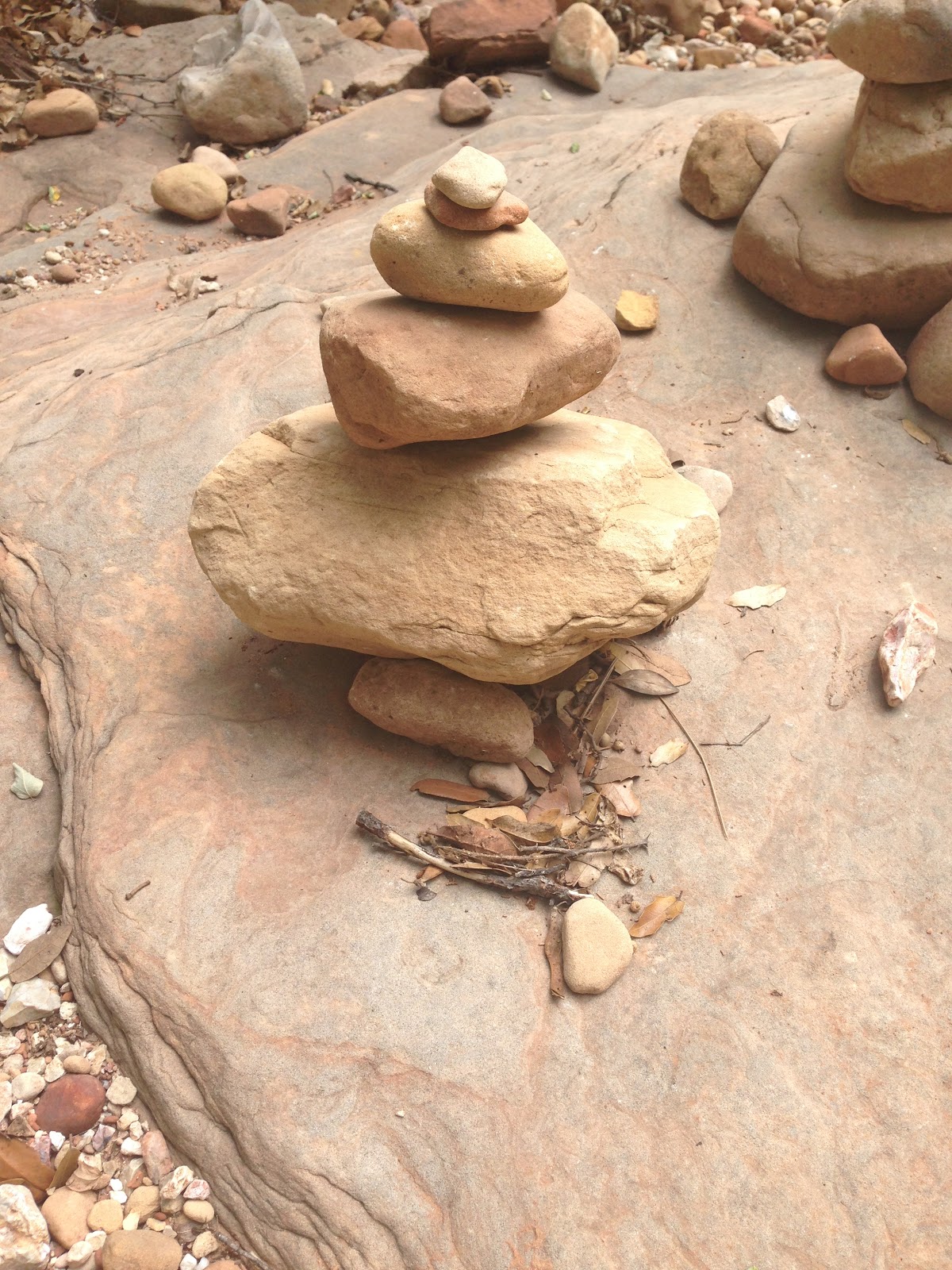
Cairns tell other hikers,
"I was here. You can do it!"
Take encouragement from those who have gone before. Moments of doubt will come. Just when you think you’ve climbed too high, taken a wrong turn, ventured too far, you see a sign that someone has gone before you. You realize that what you’re attempting is not impossible. And you keep going.


Know that the end of the trail is never the end of the trail. Trails seldom just end. They cross, loop, bisect, merge, converge, diverge. When you reach that end-of-the-trail marker, know it’s most often a lie. There are still myriad opportunities open to you. If on the rare occasion it actually is the end of the trail, enjoy the return trip. You’re sure to catch something you missed on the initial one.
 
            On the trail and in life, I wish you happy hiking!     

Tuesday, July 7, 2015

Blogging: Busking for Writers


            At fifty-five, Carl Falsgraf chucked his successful, well-paying career and set out on a forty-nine-day, round-trip journey from Eugene, Oregon, to Portland, Maine. He planned to use this time to unwind, re-charge, and reflect on what to do with the remainder of his life. Along the way he recorded his reflections and revelations, which he later shared in his travel memoir Highway Blues. A musician and songwriter, he also composed some new songs as he traveled. And—in an activity that especially interested me—he tried his hand at busking.
            As I type this post, I’m glad to see that busk is immediately underlined with a red squiggle. Spellchecker is as unfamiliar with the term as I was. But dictionary.com ensures me it is indeed a word and means “to entertain by dancing, singing, or reciting on the street or in a public place.” The web site further informs me it is a chiefly British term, and a YouTube search reveals that, British or not, it is a thriving activity the U.S.
            Falsgraf describes busking as “the most primal, challenging, and rewarding mode of musical experience.” The busker puts himself out there without the benefit of advance people, publicists, promoters, and all manner of fancy sound equipment. It’s just him, his raw performance, and his voluntary audience. Feedback is immediate: If people don’t like the performance, they walk away.
            While busking can be nerve-racking, rewards do exist. Most often they are in the form of busy passers-by who pause to listen and indicate their pleasure by smiling and maybe nodding along to the music. If they are especially appreciative, these transitory fans might toss some coins into a jar or instrument case, but don’t count on those tips to pay the bills.
            As I read Falsgraf’s explanation of the experience, it struck me that busking and blogging have much in common. In fact, I’ll venture to say that blogging is to the writer what busking is to the musician. Especially the way I do it. While there are the professional bloggers who garner huge followings and rake in mega-bucks, a glance at my blog will quickly reveal its amateur status: not a lot of money invested, not a lot of hours spent in SEO searches, not a lot of advertising and/or promotional schemes. I do have the opportunity to edit and revise before casting out my writing “pearls,” but my posts are raw in that no professional editor or even trusted writer friend has tweaked them. As for feedback, the stats quickly inform me how well received my efforts are.
            Certainly, there are no financial rewards—not even a few coins tossed my way. But, as with busking, rewards can take other forms. There is the opportunity to air my thoughts and observations (of which I have many) without the pressure of meeting a quota or deadline. I have the freedom to choose my topics “as the spirit moves me.” I get the pleasure of feedback in the forms of comments and “likes” and “shares” and in the discovery I’ve added another follower. And there is always the unexpected bonus of someone complimenting you on a post and you had no idea they even read your blog.
            It took me years to arrive at this conclusion, but I consider writing to be like any other talent. And just as there are all types of forums in which other talents can be shared, blogging provides one in which both the writing pros and the “buskers” can publicly perform.


Tuesday, October 28, 2014

Bird-brained Advice for Writing: Part IV - Finding the "Write" Reason

            In the olden days—those days before the internet and e-readers—publication was the holy grail of writers. With today’s revolutionary changes in the publishing industry, the good news is that with a little self-discipline any writer can achieve that goal. The bad news? For the majority of writers, even if we self- or e-publish, we’ll be lucky to get anyone beyond a few loyal friends and family members to read our work. And yet we persevere.
            Why do we do this? Why—in the face of frustration, failure, futility—do we slave away on our articles, manuscripts ... blogs and pray that a few folks will read what we have to say? The “bird-brains” offer some insight on this seemingly masochistic endeavor.
            In bird by bird ... Anne Lamott shares information about the ultimate reason writers do what they do. Early in her writing journey, she received scathing criticism from an editor and experienced the mortification with which many of us are familiar. But rather than ditch her story, she took his advice and “with great trepidation” sat down to revise. As she wrote, she had an epiphany: the realization that this time “I wasn’t writing the book with my thumb stuck out, trying to hitchhike into history; I just wanted to write a book for my father that might also help someone going through a similar situation.” She also discovered “There is no cosmic importance to your getting something published, but there is in learning to be a giver.”
            In Gooney Bird is Absurd, author Lois Lowry poignantly demonstrates the same message. Throughout the school year, Gooney Bird and her teacher Mrs. Pigeon work tirelessly to share the techniques and joys of storytelling with Gooney’s classmates. Through various programs and activities, the second-graders learn to appreciate the satisfaction and fun that can come from creating their own stories and poems. But not until the class experiences the death of someone dear to them do they learn the true worth of their writing. When they compose "A Goodbye Poem,” they are able to express their sympathy to the family of the departed and alleviate their own sense of loss.
            The common thread of these two stories is that they both get to the root of why we write. We write out of the desire to give and to connect. Whether we write fiction, nonfiction, poetry, or a letter to the editor, we write to share our thoughts, observances, successes, and even our failures. We hope that in baring our souls, we can somehow shed a sliver of light on others experiences. We might not be able to solve readers’ problems. But we can offer encouragement and let them know they’re not alone. For confirmation of this, check out Jennifer Cazzola's comments here.
            You might be questioning whether your writing motives are this pure. I mean, what writer among us has never dreamed of making the bestseller list, winning the Pulitzer, or landing a movie deal? Who doesn’t send out each manuscript with the secret expectation that this is the next Harry Potter phenomenon? Who doesn't blog with visions of becoming the next Pioneer Woman or the online answer to Erma Bombeck? But if you're doubting the altruistic reasons behind your writing, ask yourself this: If I had no chance of ever being published, of ever making a dime, of ever having an audience of more than one, would I still write? If your answer is “yes,” then I think you’ve found the “write” reason.            

In this my final post of "bird-brained" writing advice,
I want to introduce you to Brianna. She is my great-niece and
 the instigator behind my introduction to the Gooney Bird series.
Much like the protagonist of this series, Brianna loves stories
and imaginative outfits. And clothing that matches
too closely gives her a feeling of "ennui."


Tuesday, September 30, 2014

Bird-brained Advice for Writing: Part III - Finding the "Write" Word


            To introduce this post, I’m venturing away from the “bird-brains” for a second and sharing information from another successful writer. In his memoir On Writing, Stephen King says that every writer must equip and carry with him at all times a “toolbox.” In this metaphorical toolbox are the skills he should have on hand in order to approach his craft with confidence. The tool King insists goes on the very top shelf of the toolbox? Vocabulary.
            I know Gooney Bird Greene would concur. From the day she enters Mrs. Pigeon’s second-grade classroom, Gooney Bird’s speech reveals she has a passion for words. And her resourcefulness in acquiring a dictionary for each of her classmates helps her spread that passion. By the time the second graders present their Thanksgiving program, words such as cajole, indefatigable, incognito, admonition, and my personal favorite ennui are as natural to them as gobble, gobble is to a turkey.  
            Although Anne Lamott, doesn’t overtly state it, I infer from a passage in bird by bird ... that she also places a high priority on vocabulary. While creating a scene in a novel, she discovered she didn’t know the name of that little “wire thing” placed over the cork of a champagne bottle. Her quest for the exact word resulted in her calling a winery and conversing with a two-thousand-year-old monk (her description). (And now that you’re burning with curiosity, I’m going to let you smolder. You’ll have to read her book to find out the name. Or call a monk yourself.)
            I’m willing to bet that every person who has ever set pen to paper—with the possible exception of author Charles Portis—has struggled at one time or another to come up with the exact right word. That is why, if you are a writer, vocabulary building should become second nature to you. I’m also willing to bet, however, that it already is. How can you be a writer and not love words?
            Understand I’m not talking pretentious, stilted verbiage here. Everything I’ve read about contemporary writing cautions against using an obscure, polysyllabic word when a familiar, shorter form will work just as well. Why say somnambulating when sleepwalking gets the same point across and doesn’t send your reader scrambling mid-sentence to the dictionary?  Enriched vocabulary is about knowing many words so that you’ll have the precise word at your disposal when you need it. So that once you’ve written trinket twice in the same paragraph, you’ll know that gimcrack can serve as a good alternative. So that if you want a character to sound pompous, you can have him say imbroglio instead of spat. An enriched vocabulary enables us to clearly express sights, feelings, or experiences that otherwise might be indescribable.
            So what is the best way to build vocabulary? In Gooney Bird’s classroom, every time the second-graders hear a new word, they look it up in their dictionaries. Mrs. Pigeon tells them that once they use a word three times, they own it. For the eager second-graders, that method works well. Surprisingly, King instructs us to not make any “conscious effort to improve [our vocabulary].” He says start with the vocabulary you have and then naturally acquire words by reading . My favorite method is to read and “pay attention.” One of the reasons I enjoy my kindle is that  definitions to unfamiliar words are just a screen tap away. Upon finding a word I especially like, I highlight it. That way I can revisit it later and "own" it. When not using my kindle, I have my phone with the dictionary app nearby. Whether you work crossword puzzles, make flashcards, play word games, or simply read, the best way to increase your vocabulary is whatever method works for you.
Choose your favorite tool(s).
 

           It is difficult to describe the pleasure I derive from vocabulary building. But give me time. I’ll find the right words for it!


Wednesday, September 24, 2014

Bird-brained Advice for Writing: Part II - Paying Attention

            When my cousin Jerry found out I’d written a book, he said, “I was going write a book one time. But I got to page ten and couldn’t think of anything else to say.”
            I’ve been there. But now I can solve this dilemma in two words: Pay attention.
            Many of my author friends have lamented that they’d rather write a three hundred-page novel than a one-page synopsis. Ditto for me. That’s because without the story’s juicy details, a synopsis can be as dry as the white meat on an overcooked turkey. So where do we get all those wonderful details? By paying attention.
            As far as I’m concerned, one of the perks of being a writer—and you can claim that title regardless of where you are in the journey—is sharpening the skill of observation. Writing increases the ability to look for and recognize the details that make people or events or surroundings unique and interesting. As Anne Lamott puts it in bird by bird..., “If you start to look around, you will start to see.” Maybe you’ll start to see that it’s that slightly crooked front tooth that makes a smile so engaging. Or maybe you'll notice that the nandina bush you'd given up for dead is sprouting a few green leaves at its base. 
            Paying attention isn’t limited to what we see. Quite frequently I catch myself in a restaurant or in a line with my ear slightly leaning toward a nearby conversation. This isn’t eavesdropping. It’s research. Listening closely to conversations, wherever they occur, can alert you to the distinctions of voices, accents, speech patterns, and even mannerisms people use while talking (not to mention some interesting subject matter). Lois Lowry incorporates details such as these so skillfully in her Gooney Bird Greene series that soon the reader knows which character is speaking even before he is identified in the speaker tag. Listening extends beyond conversations. Pay attention to the sounds of nature, of music, of machinery, of windchimes.... Pay attention to the lovely and the harsh, the symphonies as well as the cacophonies.  
            Details can be gleaned from paying attention with all the senses. And they can be gleaned when paying attention when we’re reading. Some folks might consider me a snob for saying this, but I honestly do enjoy some books as much as for the way they’re written as for the plot or theme. I agree that description shouldn’t take a reader out of the story. But when skillfully done, descriptive details can plunge us more deeply into it, even when we pause and re-read a passage because it resonates with us. Of course, I’m not saying copy what another author has written and claim it as your own. But learn her technique. When you’re enjoying a particular line or passage, stop and ask yourself what makes it so enjoyable. What makes it stand out--the writer’s precise word choice, his candor, his ability to mix the ridiculous with the sublime and elicit a laugh?     
            A final, very practical word of advice about paying attention: As soon as you gather a great detail, write it down. I’m currently trying to train myself to carry pen and pad with me at all times because I’ve lost more good material to bad memory than I have to computer failure. Lamott says she never goes anywhere—even to walk her dog—without a pen and an index card. These days, those more technically savvy probably rely on phones or tablets, but I’m not to that point. Whatever works for you, use it. Just remember: Write. It. Down.
            Remember what I said about a line or passage that strongly resonates with us? This one from bird by bird...did it for me: “There is ecstasy in paying attention.” Amen.   

Friday, August 15, 2014

Reading About Writing

            Just because I’m waaay behind on my self-inflicted goal of creating a post at least every two weeks, that doesn’t mean I’ve been totally neglecting my writerly duties. Sometimes writing pursuits include activities other than putting pen to pad—or fingers to keyboard. Sometimes the best thing a writer can do to improve her craft and jumpstart her creative juices is read. And more specifically, read about writing.  
The Book Nest - Not Your Ordinary Bookstore
            About a year ago, I picked up a used copy of Traveling Mercies by Anne Lamott at my niece’s little book nook. I’d heard of Lamott for years but never got around to reading her. Since I qualified for the good relative discount at The Book Nest, I grabbed the copy with a what-the-heck attitude. If I didn’t like it, at least I wasn’t out a wad of money.
            As it turned out, I got a lot for my $4.95 investment. (And no tax! Oregon has no sales tax!) Let me say up front, I don’t see eye to eye with all of Lamott’s religious and political views. But I found Traveling Mercies full of funny, witty, honest, and passionate observations on her life and her writing journey. I enjoyed the book so much that when I saw her book Bird by Bird: Some Instructions on Writing and Life at another used bookstore (you’re learning where I do a lot of hanging out), I snapped it up. Once again, it was a shrewd purchase.
            What I like about Bird by Bird is the “instructions” on writing don’t really seem like instructions at all. They aren’t technical “to do’s,” promising a New York Times bestseller. But while her advice isn’t a paint-by-numbers guide to constructing plot or developing scenes, it is  tremendously helpful. She gives practical guidance on generating content, overcoming writer’s block, and finding one’s voice. There’s even a chapter on dealing with professional jealousy (not that I or anyone I know ever deals with that).
            My favorite take-away from this book, though, is the author’s thoughts on publication. If you read this book with dreams of discovering the sure road to Big Five publication, those dreams are most likely going to be dashed. Or at least broken and bruised a bit. In fact, Lamott cautions you—very nicely and with lol humor—you’ll be lucky to receive anything other than a form rejection from an agent. But once you’ve massaged your injured hopes and resisted the urge to shred your three-hundred-page manuscript, you’ll find inspiration in her words. And you’ll discover the real reason to write.  


Wednesday, July 16, 2014

The Parable of the Verbena Seeds

            A woman desired a beautiful flower garden, so in early spring she planted verbena seeds in starter containers and carefully tended them. She watered the seeds faithfully, protected them from cold snaps and storms, and looked forward to the day she could transplant them into her garden and enjoy their beautiful blooms.

            But in the night an enemy—or a bird or a strong wind—visited her makeshift greenhouse and sowed seeds of a different kind. And it came to pass that in late spring a careful inspection of her seedlings revealed fuzzy little stalks and leaves, which mightily resembled those of tomato plants. As the stalks grew in stature, delicate yellow blossoms appeared on them. Verily, they were tomato plants!            
            This woman had always held fast to the belief that actions carry consequences. Confident that her actions in nurturing these seeds had been good and well intentioned, she was certain her efforts would be rewarded. 
            “How can this be?” she lamented to a friend. “I have always adhered to the belief that actions carry consequences. I sowed verbena seeds and diligently cared for them. I have been a good and faithful gardener and should have beautiful blossoms to show for my efforts. Instead, all I have are a few pitiful tomatoes.”
            The friend gave her a sympathetic smile. “It is true that actions carry consequences, and in the grand scheme of things, remembering that will ensure a life well lived. But sometimes our actions—even the best and most sincere of them—don’t always bring the results we expected. That is when we accept what we are given and make something good of it. That is called fortitude.”
            As the woman pondered these words, the friend continued. “Other times our actions are not admirable, and we suffer because of them. That is justice.”
            The woman nodded, understanding the fairness of this situation.
            “But there are also times,” the friend said, “when our actions are shameful, and yet we escape the consequences altogether. That, my dear one, is called grace.”
            The woman thanked her friend for her wise counsel. Then, with a grateful heart, she gathered the tomatoes and took them inside her house to make a salad.


Tuesday, July 8, 2014

Word Nerd

           The other day a friend posted her results of one of those Facebook quizzes. You know, one of those that tells you what kind of animal, car, state, cookie you most resemble? I generally scroll right past them, but this particular quiz caught my interest. It claimed to identify the kind of “thinker” one is, and it classified my friend as a Linguistic Thinker. Such a thinker, along with other traits, “...is intrigued not only by the meaning of words but also by the sounds of them and their rhythm.” 
            I was positive I was a Linguistic Thinker as well. More and more these days, I find myself in awe of words, either spoken or written. They don’t necessarily have to be complicated, polysyllabic words, although it’s okay if they are. As long as they communicate ideas with sincerity and clarity, I’m impressed. Add a touch of local color or creative flare or—as stated above—arrange them in a particularly mellifluous combination, and I’m downright gobsmacked. (How do you like that last word?)
Martha Bryant, on the left, claimed the
title of current reigning Word Wizard
with the word gunsel. Look it up.
Rest assured, the competition to unseat
her at our next gathering will be fierce.
            I don’t claim to be a philologist (another great word!) by any stretch  of the imagination. I’m not an expert who applies “a critical attitude toward words, their roots and their meanings.” (WSJ, 4/5/14). Rather I’m a dilettante—a dabbler in diction, an amateur tripping through a garden of wordly delights. A word nerd, if you will. I often enjoy a book as much for the way it’s written as for the story. As a rule, card and board games don’t interest me, but give me one involving words and I’m all over it. I’m a faithful solver of the Daily Cryptoquote in the newspaper. (I used to be obsessed with crossword puzzles but gave them up when I realized what a timesuck they were becoming.) Only a word nerd would have dictionary.com for her homepage, right? And who else but a word nerd would spend an entire evening with other “nerders” (aka the Inklings) in a cut-throat, high-stakes word tournament, vying for the title of Word Wizard?
            So with all this evidence of my linguistic leanings, I saw no need to take the quiz. But I did. I breezed through it, scoffing as I clicked off the too obvious answers that would identify me as a...Philosophical Thinker??? What? Surely not! Philosophical Thinker couldn’t possibly apply to the person who gave up reading Sophie’s World because she couldn’t follow the geared-to-middle-schoolers explanation of existentialism. The same person who, full of ambitious optimism, bought a book entitled Half Hours with the Best Thinkers and fell asleep fifteen minutes into the very first half hour. The person who pored over the two-paragraph explanation of secular humanism in the The Bathroom Book Edition III and still remains clueless on the subject.  
            Needless to say, I’m crushed. My entire thinking paradigm now must shift from “What is the meaning of this word?” to “What is the meaning of life?” and let me tell you that is a major shift. Quite frankly, I’m not sure at my age I’m up to the challenge. One thing I am sure of, however, is that I’m through with Facebook quizzes. A few more life-altering discoveries like this one, and I’ll be lucky if I can think at all.   

            Want to know what kind of thinker you are? Here’s the link. But be forewarned. You might not like the results.


Monday, May 19, 2014

More Writing About Writing

            Shel Harrington (the divorce attorney who doesn’t like divorce) invited me to participate in a blog hop that asked the following questions of writers. Fortunately for me—and unfortunately for you—this opportunity comes at a time when I’m excited about some upcoming projects and possibilities. The result is a rather lengthy post, but that's what you get when you ask a writer to write about writing.
What are you working on?
Lots going on right now, and I like it that way.

I currently have several projects in the works, but probably the one I’m most enthusiastic about is converting Beyond the Farthest Star to an ebook. I’ve been contemplating this for a couple of years, and finally—with encouragement from Sarah Basore—decided to go for it. The determining factors were a couple of workshops at the recent OWFI Conference. This a revolutionary time in the book publishing business, and much of the stigma of self-publishing is vanishing. I’ve weighed the pros and cons, and lately it seems the scales are tipping in favor of the pros. Also, I think my tolerance for risk-taking has grown. Sooo, in the not-too-distant future, look for my book on your favorite reading device!
Other projects include my finished manuscript, a women’s fiction piece with the working title Crossroads. My initial experience with electronic publishing will influence the course I take with it.  I’m also just beginning a book which centers on a woman getting out of prison and beginning a new life. I’m still blogging (obviously), and I’m trying to enter more contests these days. 
How does your work differ from others in its genre?
A tough question because as the verse in Ecclesiastes states, “There is nothing new under the sun.” So I’ve taken tried and true themes and—I like to think—added fresh twists. For example, BtFS is basically about bullying, friendship, and young love—definitely nothing new in young adult fiction. But I gave it an unexpected ending. In Crossroads, I borrow on the “reversal of fortune” idea. My pitch for this story: Take the Jasmine character in the movie Blue Jasmine—or Blanche DuBois in A Streetcar Named Desire—and set her in the middle of Oklahoma with no drugs and better friends.
Why do you write what you do?
First, I blog because thoughts and ideas bounce around in my head like marbles in a pinball machine. Some of those thoughts I want to share and get feedback on. Others I just want to get out of my head before it explodes. Some are serious (gems), some completely inane (gimcracks). As far as books go, I also learned at the OWFI Conference that I can classify my work as inspirational women’s fiction. I was thrilled to learn this because I’ve struggled for some time with pinpointing the category in which I write. My work isn’t overtly Christian, but it’s based on a Christian world view, and I make references to Christian beliefs. I want my writing to entertain—and hopefully elicit the occasional laugh—but I also want it to inspire, to leave the reader with a sense of hope.  
How does your writing process work?
Huh? I’m supposed to have a process? No, really, I guess I do have a process. I just don’t have a routine. I don’t get up each morning, have a cup of coffee, and devote the next four hours to writing. But, like probably 90% of bloggers, I have a mile-high stack of newspaper articles or slips of paper with thought-provoking quotations or subjects I use to generate content. Or sometimes I just elaborate on observations I’ve made as I grow older and go about my daily life. Regardless of where the ideas originate, I try to remain consistent with my posts, writing one at least every one or two weeks. Blogging regularly is good for me. It requires a modicum of self-discipline, and when you’re retired from a “real” job, self-discipline can present a challenge. Another part of my so-called process is belonging to the Inklings, a writing group. If you aspire to be a serious writer—serious being a relative term—a writing group is the best thing you can do for yourself. The group will encourage you, feed your creativity, give you honest feedback, and hold you accountable. Plus, you’re guaranteed there will always be a few people who’ll read what you wrote.
As far as my process for writing a novel, I try to write a general outline first and then write the scenes in chronological order. I also write down events on a calendar as they occur, so I can keep the time sequence straight in my mind. Not everyone adheres to this plan, but it works best for me, even though I do adjust the plot for characters who won’t cooperate.
This is probably waaay more information than anyone wanted. If you’re still reading at this point, I thank you from the bottom of my heart and applaud your tenacity.
Next Monday, the destination on the tour will be Marisa Mohi’s blog. A member of Oklahoma WomenBloggers and self-described “unprofessional librarian,” Marisa brings her unique perspective to a variety of subjects.

Monday, January 27, 2014

Keep On Scrollin'

            A sad thing happened today. I lost a friend. Before you start extending condolences, let me clarify this was a Facebook friend. And I didn’t lose him physically...just on Facebook.
            His Facebook demise wasn’t sudden or without warning. He gave all his friends a heads up a few days ago that he’d be signing off. Something about “mountains being made out of molehills.” Don’t know what he meant exactly, but he sounded a little bitter. 
            We’ve all heard the complaints: Facebook is just a place to brag, to “overshare,” to bully. And, of course, there’s the constant, pervading complaint that it’s a waste of time. I’ve been known to register a few complaints myself. But here’s what I’ve learned about Facebook or any form of social media: It’s a tool to use however I want. In fact, for me, it’s one of the few areas of my life where I feel—for the most part—in control. 
            For instance, I can pick my friends. Well, the ones that subscribe to Facebook. And I have quite a variety. They run the gamut from left-wing liberals to far-right conservatives. From twenty-somethings to grandparents. From close relatives to people I know only through Facebook. I even follow a couple of authors I like, although I avoid any fanatical following of the rich and famous...or the rich and ridiculous.  
Best device I've found for
managing Facebook. Inexpensive,
lightweight, and (hopefully) I'll never lose it.

            Facebook provides all sorts of ways to manage friends so that I can choose which ones I want to keep up with most. But what I’ve found most effective in managing time and friends is...wait for this...my finger. Yes, that little non-tech device that is with me wherever I go has enabled me to not only survive Facebook but to enjoy it.
             First, if I don’t have time for Facebook, I don’t click on it. What a concept! But if I do have some downtime, I enjoy scrolling through a few posts, catching up on what friends and family are doing, viewing pictures. That’s another way my finger comes in handy—scrolling. I generally glance at the recent posts on the news feed, pausing to read the ones I find interesting, and scrolling past the ads, most of the links, and posts of the 150 cute things someone’s kid or pet has done THAT DAY. If you happen to enjoy cute things that kids and pets do, great! That’s the beauty of Facebook. You can pause and read and even comment...or you can keep on scrollin’.
            Same thing goes for posts I’m pretty sure are going to irritate me. I scroll right past. I’m all for people expressing their opinions. I just don’t feel the need to read them. And I sure don’t feel the need to respond to them. Occasionally, I’ll hit “like” if I agree with a particular stance, but, in general, I prefer my political discussions to be in person. But, hey, if a heated Facebook argument is your idea of fun—or if you feel strongly led to publicly state your opinion—go for it. Just don’t get your feelings hurt when people feel equally led to disagree. Or drop you as a friend. As for me, I get enough political angst from watching TV news without getting embroiled in a Facebook debate.
             And speaking of TV, it comes with an “Off” button. That’s another place you can put your finger to effective use.